If you want to know how to get cited by AI - named directly inside a ChatGPT, Copilot, or Perplexity answer, or inside a Google AI Overview - the discipline is called generative engine optimization (GEO), sometimes referred to as answer engine optimization (AEO). It’s the practice of structuring content so AI systems cite it directly when answering a user’s question. It’s the newest layer on top of traditional SEO, and it rewards a different set of signals than ranking in a traditional blue-link SERP: clarity, direct answerability, and structural machine-readability matter more here than they do for a page competing purely on backlinks and keyword targeting.
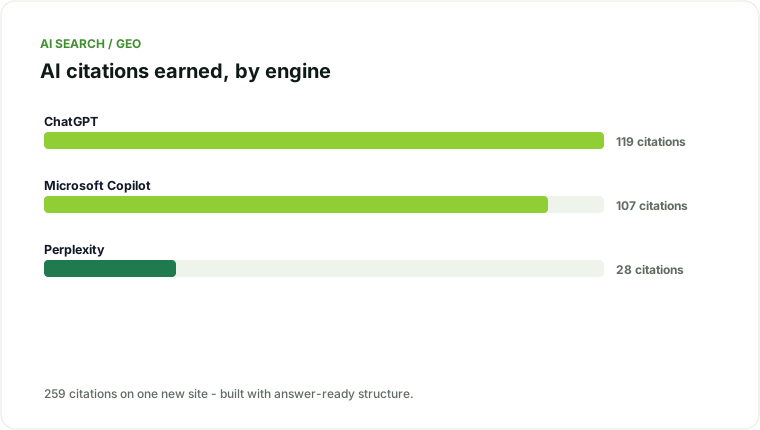
I’ve built content that earned 430+ documented AI citations across two client programs - 259 citations for a golf equipment and instruction site across ChatGPT, Copilot, and Perplexity, and 133 for a retail site, including 23 citations specifically inside Google AI Overviews. This isn’t a theoretical framework; it’s the pattern that produced those citations, adapted so you can apply it to your own content.
Why this matters now
AI answer surfaces are increasingly where a meaningful share of informational queries get resolved without a click to any website at all. Being cited inside that answer - named as the source, ideally with a link - is the closest thing to visibility left in that scenario. Sites that show up consistently as cited sources are getting brand exposure and occasional referral traffic even when the traditional click never happens; sites that don’t show up at all are becoming invisible for exactly the queries where a competitor’s content is filling the answer instead.
This is not a replacement for traditional SEO - the two overlap heavily, and content that ranks well tends to be more citable, not less. But the specific signals that push a piece of content from “ranks fine” to “gets cited by name in an AI answer” are distinct enough to be worth optimizing for deliberately.
How GEO differs from traditional SEO
The overlap is real, but the differences matter for how you prioritize work:
- The unit of ranking is different. Traditional SEO ranks whole pages against a query. AI systems often extract and cite specific passages or sections within a page, which means a single strong paragraph can earn a citation even if the rest of the page is average - and conversely, a page that ranks well overall can still get passed over for citation if the specific answer isn’t cleanly extractable from it.
- Backlinks matter less directly. Traditional rankings lean heavily on authority signals built through links. AI citation appears to weight extractability, clarity, and topical authority more heavily relative to raw link count - which is part of why a newer or smaller site can earn citations faster than it could earn equivalent traditional rankings.
- There’s no single “position” to track. A page either gets cited for a given query or it doesn’t, and multiple sources often get cited together in the same answer - it’s not a zero-sum ranking ladder in the same way traditional SERPs are.
- Freshness and specificity are weighted differently across platforms. Perplexity and Google AI Overviews both lean on live retrieval and tend to favor current, specific content; ChatGPT’s behavior depends heavily on whether browsing/search is enabled for a given response, which makes it the least consistent of the three to test against.
What AI systems actually look for when citing a source
Based on the pattern across the two programs referenced above, a handful of structural and content traits correlate strongly with getting cited:
- A direct, extractable answer near the top of the page. AI systems favor content that states the answer plainly before elaborating, rather than building up to it through a long narrative introduction. A clear one-to-three-sentence answer to the implied question, positioned early, is far more citable than the same information buried in paragraph six.
- Clear structure with descriptive headings. Content organized into well-labeled sections (not just visually, but semantically - actual heading tags, not bolded paragraph text) is easier for these systems to parse, extract, and attribute to a specific section.
- Specific, checkable facts and numbers. Vague claims get paraphrased or ignored; specific figures, named methodologies, and concrete claims get quoted more often, because they’re more useful as a citable fact.
- Original data or a distinct point of view. Content that only restates what’s already broadly available has nothing unique to cite - the AI system will synthesize from wherever that information is most authoritative or most repeated across sources instead of naming any single one. Content presenting original research, a proprietary method, or a genuinely distinct take is more likely to be the one selected and named.
- Clean technical accessibility. If an AI crawler can’t access or properly parse your content (blocked by robots.txt, rendered only via heavy client-side JavaScript with no server-rendered fallback, or behind aggressive bot-blocking), none of the above matters - it can’t cite what it can’t read. This overlaps directly with the crawlability fundamentals in a standard technical SEO audit.
- Structured data and schema markup. FAQ schema, HowTo schema, and Article schema with clear author and organization markup give these systems an explicit, machine-readable signal about what a page is and what it’s answering - the same schema work that supports traditional rich results also supports AI extraction.
The content pattern that earned 430+ citations
Across both programs, the content that got cited most consistently shared a specific shape:
- Question-led structure. Headings phrased as the actual questions people ask, not generic topic labels - “How long does it take to break 90 in golf?” outperforms “Improving Your Golf Score” as a citable heading, because it mirrors how the query itself is likely phrased.
- Answer-first paragraphs under each heading. The first sentence or two under each heading directly answers that heading’s implied question, with supporting detail following after.
- Genuine expertise markers. Author bios and content that reflect real, first-hand experience - not generic buying-guide language recycled across the web - correlated with more frequent citation, consistent with these systems favoring sources that read as authoritative rather than derivative.
- Comparison and list formats where the topic calls for it. Structured comparisons (tables, numbered lists, clear criteria) are highly extractable and were disproportionately represented among the most-cited pages in both programs.
- Freshness signals. Visibly updated dates and content that reflects current information (not stale advice from several years prior) appeared to be weighted favorably, particularly for Google AI Overviews specifically.
The retail site’s 23 Google AI Overview citations in particular tracked closely with pages that combined structured comparison content with solid technical fundamentals (fast load times, clean schema, clear crawlability) - reinforcing that GEO doesn’t replace technical SEO, it adds a content-structure layer on top of it.
How to measure whether it’s working
Unlike traditional rank tracking, there’s no single standardized tool yet for AI citation tracking, though the category is developing fast. Practical approaches in the meantime:
- Manual query testing. Run your target questions through ChatGPT (with browsing/search enabled), Copilot, and Perplexity periodically, and check whether your domain is cited, and for which specific pages.
- Referral traffic segmentation. Check analytics for referral traffic from chat.openai.com, perplexity.ai, and copilot.microsoft.com specifically - a rising trend here is a leading indicator even without direct citation counts.
- Google Search Console for AI Overviews. Google increasingly surfaces some AI Overview appearance data within existing Search Console reporting; watch this as it matures rather than relying solely on manual spot checks.
- Dedicated citation-tracking tools. A growing category of tools specifically track brand and domain citations across AI platforms - worth adopting once you have enough content volume to make manual tracking impractical.
Where to start if you’re doing this for the first time
Don’t try to retrofit an entire content library at once. Start with your highest-value existing content - the pages already ranking reasonably well or covering topics core to your business - and restructure those first: answer-first paragraphs, clear question-based headings, specific facts over vague claims, and clean schema. Measure citation appearance on that smaller set before rolling the pattern out site-wide.
A practical starting checklist for an existing page:
- Identify the single question the page is most likely to be cited for, and confirm it’s answered directly within the first two to three sentences under the relevant heading.
- Convert vague topic headings into question-phrased headings that mirror how someone would actually ask.
- Add or verify FAQ, Article, or HowTo schema matching the visible content.
- Replace generic claims with specific, checkable numbers or named methodology wherever possible.
- Confirm the page renders its core content server-side (or via a crawlable fallback) rather than relying entirely on client-side JavaScript.
- Add or update a visible last-modified date if the content is genuinely current.
This is a genuinely new differentiator in a market where most competitors haven’t started thinking about it yet - which is exactly why it’s worth building the habit into your content process now rather than after it becomes standard practice. The programs referenced above didn’t earn 430+ citations from one big push; they earned it from applying this pattern consistently across a large content base over time, with the technical foundation solid enough underneath that nothing blocked the content from being read in the first place.
If you’re building a content program and want the technical and structural foundation checked before investing heavily in a GEO push, that overlaps substantially with a standard SEO audit services engagement - since a site AI systems can’t crawl and parse cleanly won’t get cited no matter how well the content itself is structured.
Traffic sliding, or planning a risky migration?
I diagnose why organic traffic dropped and reverse it - core updates, migrations, cannibalization, technical decay.
Explore SEO recovery services