If you’re asking how much to charge for an SEO audit - or how much you should expect to pay for one - the honest answer is that price tracks the depth of the audit, not a fixed industry rate. A quick automated report generated by a tool in ten minutes and a hands-on manual audit that catalogs every technical issue on a 250-page site are both called “SEO audits,” and they can differ in price by a factor of twenty. The useful question isn’t “what’s the going rate” - it’s “what does this specific price point actually include.”
What drives technical SEO audit price
Site size and complexity. A 20-page brochure site and a 2,000-page e-commerce catalog require fundamentally different amounts of crawling, cross-referencing, and manual review. Price should scale with the number of templates and the depth of the site architecture, not just the raw page count - a site with five well-structured templates repeated 500 times is faster to audit than a site with 500 uniquely structured pages.
Automated vs. manual review. A tool-generated report (Screaming Frog export, Ahrefs Site Audit, similar) can be produced cheaply because the tool does the work. What you’re actually paying a consultant for is the interpretation - knowing which of the 600 flagged “issues” are genuinely costing traffic and which are noise, and prioritizing accordingly. That interpretation is the expensive, valuable part, and it’s what separates a $99 automated report from a properly scoped audit engagement.
Deliverable format. A raw spreadsheet of findings costs less to produce than a prioritized roadmap with a P0-P2 severity ranking, an implementation plan, and a walkthrough call. Both are legitimate deliverables at different price points - just be clear on which one you’re buying.
Access and data available. An audit run purely from a crawl is faster (and cheaper) than one that also incorporates Search Console history, analytics, backlink data, and log files. The latter is more accurate - it tells you what’s actually happening rather than what a crawl infers - but takes proportionally longer.
Historical context. Auditing a site that just dropped 70% of its traffic after a core update requires correlating the technical findings against a timeline of changes and update rollouts - more investigative work than a routine health check on a stable site.
Typical price ranges, and what each buys
Rates vary by market and by consultant experience, but as a general shape of the market:
- Automated tool report, self-reviewed ($0-$150): you run the crawl yourself or via a cheap automated service and interpret the output. Fine for a sanity check on a small site; risky as the sole basis for a big decision, since there’s no experienced eye separating signal from noise.
- Single-consultant diagnosis ($99-$500): a real person crawls the site, cross-references Search Console, and delivers a prioritized findings document, usually within a few days. This is the right tier for “something’s wrong and I need to know what, fast.”
- Full audit + implementation ($500-$3,000+): the audit plus the consultant or agency actually fixing the priority issues, not just listing them. Price scales with site size and how many of the found issues get implemented versus just documented.
- Ongoing technical SEO management ($500-$2,000+/month): continuous monitoring, monthly re-audits, and fixes as new issues emerge - appropriate for sites large or fast-changing enough that a one-time audit goes stale within a quarter.
A red flag worth naming: any audit priced suspiciously low that promises a fixed “number of issues fixed” without ever looking at your specific Search Console data. Volume-based pricing on a generic checklist, with no site-specific interpretation, tends to produce a long list of low-impact findings that make the report look thorough without moving traffic.
Why an SEO audit is important (and why you need one before, not after)
The honest case for spending money on an audit isn’t “SEO best practice” in the abstract - it’s that technical issues compound silently, and the cost of finding them late is almost always higher than the cost of the audit itself.
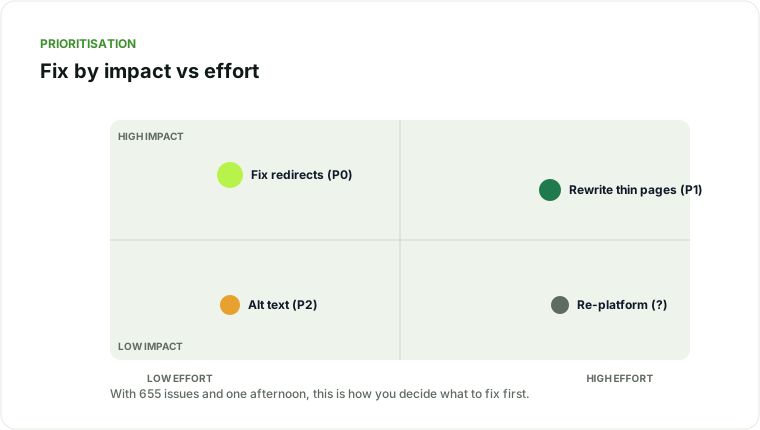
On one audit I ran for a Singapore immigration consultancy, the crawl and Search Console review together surfaced 655 individual technical issues across 254 pages, and - more valuable than the issue count - revealed that roughly 80% of the site’s 2.2 million monthly impressions had zero commercial intent. That second finding didn’t come from a checklist; it came from cross-referencing crawl data against actual query-level performance. No amount of new content would have fixed that on its own - the audit redirected the entire content strategy toward the traffic that could actually convert.
Separately, the technical foundation built and audited on one of Vietnam’s largest medical content portals supported growth from 1.3 million to 5.4 million monthly visits. An audit at that scale isn’t a one-time cleanup - it’s the difference between a site that can absorb 4x growth without falling over technically, and one that hits an indexation or crawl-budget ceiling halfway there.
You need an audit specifically when:
- Traffic dropped and you don’t know why (see the organic traffic drop diagnosis framework for the decision tree this maps to)
- You’re about to invest heavily in new content and want to confirm the technical foundation can support it
- Your last audit is more than 12-18 months old, or predates a redesign/migration
- Traffic and impressions look healthy but leads or conversions don’t match
What a real audit deliverable includes
Whatever price point you land on, a properly scoped technical SEO audit should include, at minimum:
- A full-site crawl, not a sample, covering crawlability, indexation, architecture, Core Web Vitals, structured data, and on-page fundamentals - the same five areas covered in the technical SEO audit checklist.
- Search Console cross-reference, since a crawl alone can’t tell you how Google has actually been treating the site - indexation status, impressions, and manual actions all live in GSC, not in a crawler’s output.
- A prioritized list, not just a raw issue count. “655 issues found” is meaningless without a P0-P2 ranking by traffic and revenue impact.
- A written explanation of the “why,” not just the “what.” A good audit tells you why a given issue matters for your specific site and traffic profile, not a generic description copied from a knowledge base.
- A clear next step. Whether that’s a fix list you implement yourself or an engagement where the fixes get implemented directly, the audit should end with a decision point, not just a document.
What I charge for an SEO audit, and why
My own audit engagements start at a fixed, low-commitment $99 Recovery Diagnosis delivered within 72 hours - a prioritized technical audit of why traffic dropped and what to fix first, with no obligation beyond that. It exists specifically so a site owner can get a real, interpreted answer before committing to anything larger. From there, a Recovery Sprint (from $500) covers implementation - I fix the priority issues directly rather than just listing them - and Ongoing Management ($990/month) covers full diagnosis, fixes, and monthly reporting for sites that need continuous attention rather than a one-off project.
The reasoning behind that structure: most site owners don’t yet know whether their problem is a quick technical fix or a deeper structural issue, and a large upfront commitment before that’s established is a bad trade for both sides. Start small, get a real diagnosis, and only scale the engagement once the diagnosis shows it’s warranted.
If you want to see the full breakdown of what’s included at each tier, the SEO audit services page lays out all three engagement levels with what’s included at each.
Traffic sliding, or planning a risky migration?
I diagnose why organic traffic dropped and reverse it - core updates, migrations, cannibalization, technical decay.
Explore SEO recovery services